Train PyTorch models directly from a Rerun server.
The experimental dataloader module exposes Rerun recordings as iterable or map-style PyTorch datasets, decoding compressed video (h264/h265/av1), images, and scalars on the fly. Random access, multi-worker prefetching, and DDP partitioning all work out of the box.
The full code for this guide lives in examples/python/dataloader/, which trains a LeRobot ACT policy from a HuggingFace dataset.

Training sample construction
A vision-language-action policy is trained on samples that align several columns of multimodal data at the same instant in time:
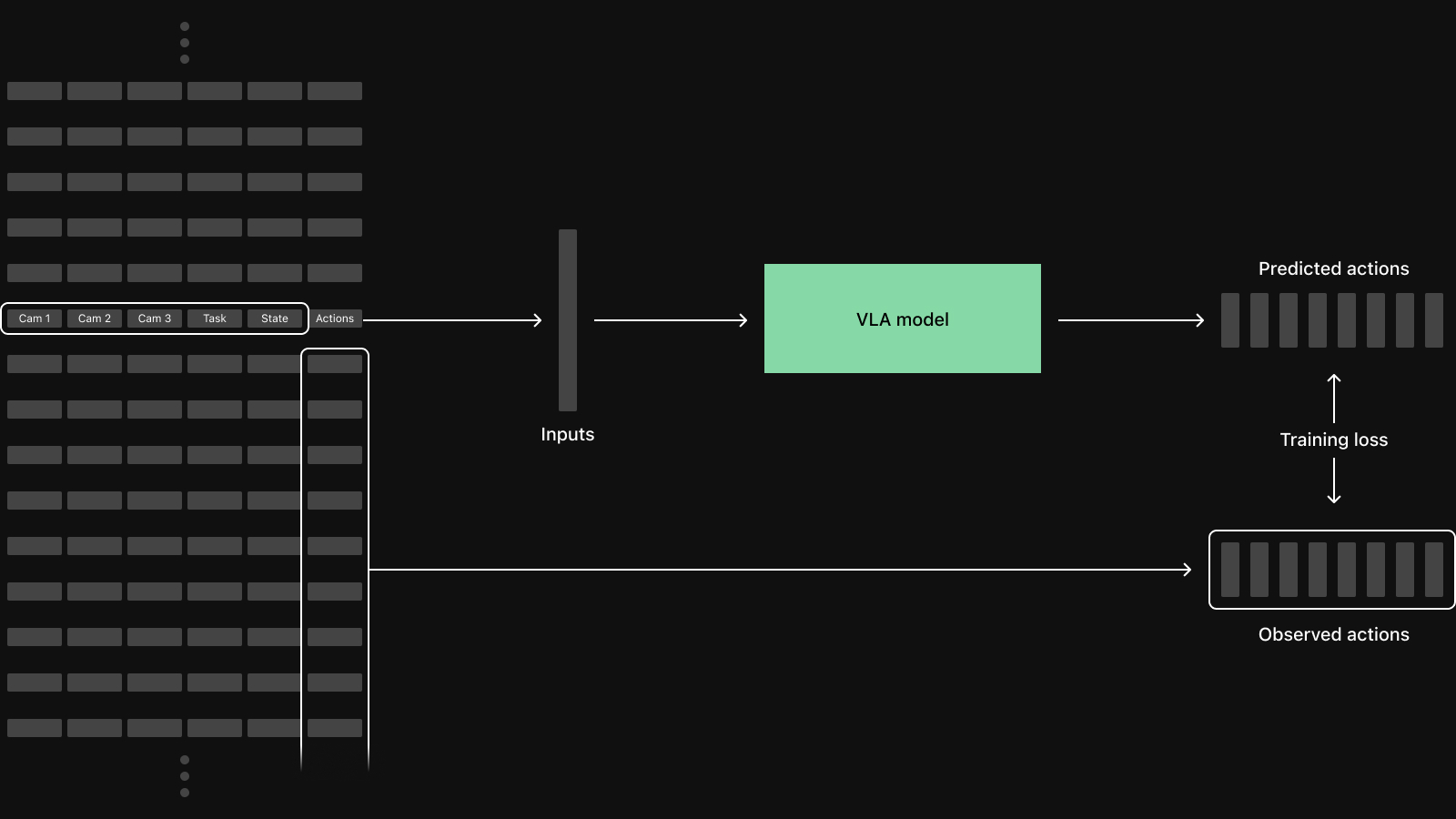
The dataloader assembles those samples on demand from the per-recording chunks in a Rerun catalog, while the PyTorch DataLoader drives batching, shuffling, and worker parallelism.
How to use it
Register data with a catalog
The dataloader reads from a Rerun catalog, so you must first register RRDs. Start the OSS server in a separate terminal:
rerun serverThen register your recordings. Each registered RRD becomes a segment in the dataset, typically one episode or trajectory per RRD:
client = rr.catalog.CatalogClient(server.url())
dataset = client.create_dataset("my_robot_data", exist_ok=True)

uris = [f"file://{p.resolve()}" for p in rrd_paths]
dataset.register(uris).wait()
The example's prepare_dataset.py shows the full flow for converting a HuggingFace LeRobot dataset into per-episode RRDs and registering them.
Describe a sample
A Rerun dataset is built from three things:
- a
DataSource: the catalog dataset and an optional segment filter - an
index: the timeline that defines what "one sample" means (e.g."real_time"or"frame_index") - a dict of
Fields: what each sample should contain
from rerun.experimental.dataloader import (
    DataSource,
    Field,
    FixedRateSampling,
    NumericDecoder,
    RerunIterableDataset,
)

source = DataSource(
    dataset=client.get_dataset("my_robot_data"),
    segments=[
        "ILIAD_50aee79f_2023_07_12_20h_55m_08s",
        "ILIAD_5e938e3b_2023_07_20_10h_40m_10s",
    ],
)

fields = {
    "state": Field(
        "/observation/joint_positions:Scalars:scalars", decode=NumericDecoder()
    ),
    "action": Field(
        "/action/joint_positions:Scalars:scalars", decode=NumericDecoder()
    ),
}

ds = RerunIterableDataset(
    source=source,
    index="real_time",
    fields=fields,
    timeline_sampling=FixedRateSampling(rate_hz=15.0),
)
Each Field.path is a column name from the dataset's catalog schema.
The decoder turns that column into a training value:
NumericDecoder()for scalar and list-of-scalar columnsImageDecoder()for encoded image blobs (JPEG/PNG)VideoFrameDecoder(codec=…)for compressed video (h264/h265/av1)
The dict keys ("state", "action", …) in fields become the keys of each sample dict that the dataset yields. When the index is a timestamp timeline (like "real_time" above), pass timeline_sampling=FixedRateSampling(rate_hz=…) so the dataloader knows how to lay out the sampling grid.
Action chunks and history via window
Field(window=(offset, …)) returns one value per explicit offset relative to the current index, instead of a single value.
Integer timelines use integral index-step offsets. Timestamp and duration timelines use seconds, which the dataloader converts to nanoseconds internally; callers never need to match the Arrow timestamp storage unit.
Field(max_staleness=…) uses the same convention when limiting the age of the nearest value during manifest generation.
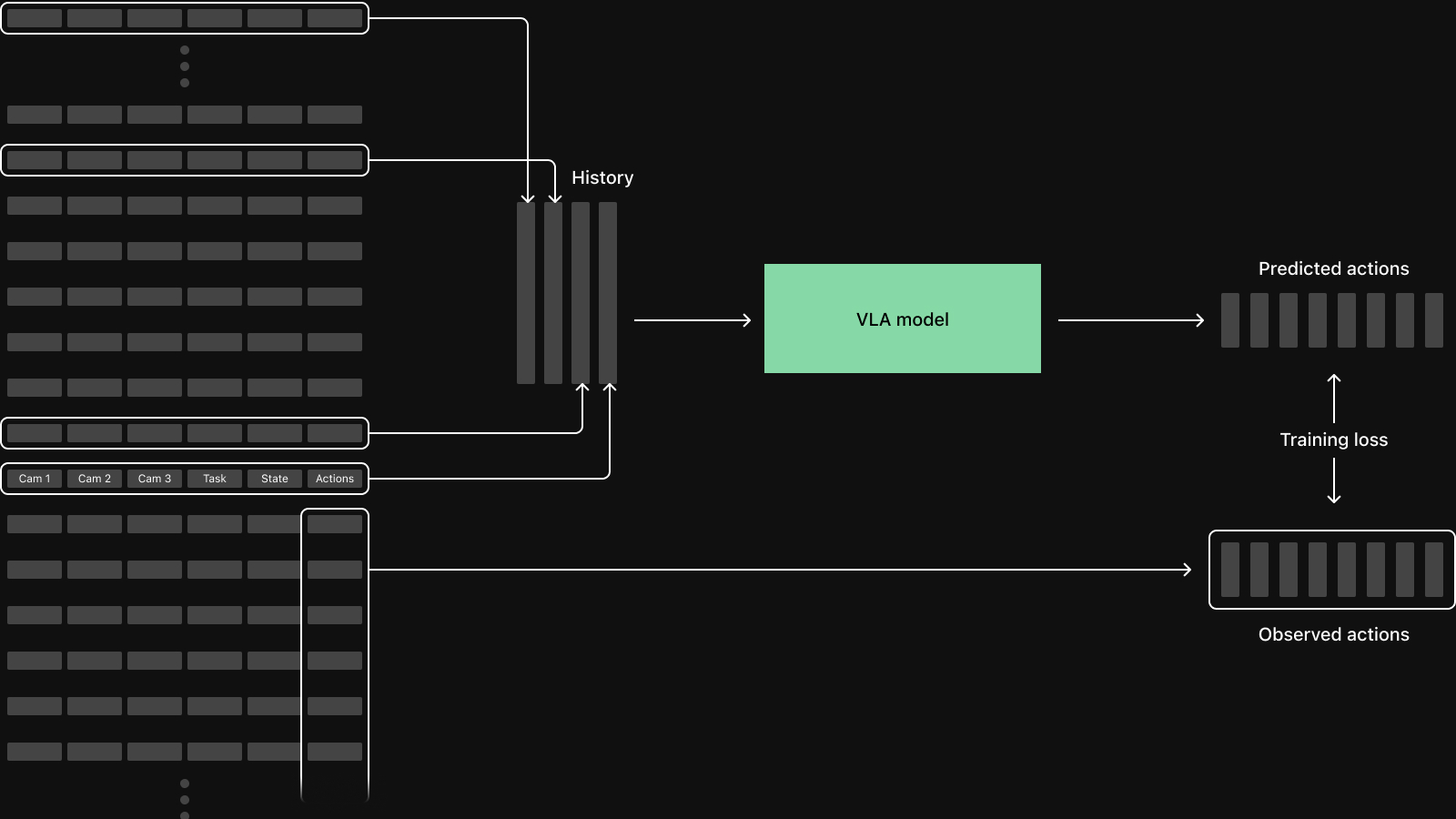
# Each sample now carries the next 50 action steps instead of a single value.
# The selected index above is a timestamp timeline, so these offsets are
# expressed in seconds.
# An integer index timeline would instead require integral index-unit offsets.
windowed_action = Field(
    "/action/joint_positions:Scalars:scalars",
    decode=NumericDecoder(),
    window=tuple(step / 15.0 for step in range(1, 51)),
)
The example uses this to feed 50-step action chunks into the ACT policy.
With VideoFrameDecoder, a window returns one decoded frame per explicit offset as a [T, 3, H, W] tensor.
VideoFrameDecoder(window_storage="view") collects decoded RGB frames in a common frame buffer and returns views for contiguous windows.
The decoder fills that buffer as frames are converted to RGB, avoiding a separate stacking allocation for the shared buffer.
RGB conversion contexts are reused within each thread.
Overlapping windows share storage, so treat them as read-only until collation.
For GPU training, VideoFrameDecoder(output_format="yuv420p", window_storage="view") instead returns compact YUV planes, shares decoded storage across overlapping windows, and defers RGB conversion until after device transfer.
With NumericDecoder, every resolved numeric-list row in a window must have the same width, producing a [T, D] tensor (including [T, 1] for a scalar component).
Variable-width window rows decode to None rather than being flattened and losing their time boundaries; the live iterable dataset treats that sample as missing.
Unwindowed variable-sized values such as point clouds remain supported as one tensor per sample.
Batch them with a custom collate_fn that pads and returns a mask, samples a fixed number of elements, or concatenates values and returns batch offsets.
Padding belongs in the collator because only it knows the maximum size of the actual training batch.
For CPU tensors, NumPy arrays, numbers, and YUV frames, rerun.experimental.dataloader.PooledBatchCollator reuses shared CPU buffers for worker-to-consumer batches on Linux.
It supports nested dictionaries, lists, and tuples with matching structure, shapes, and data types across samples.
Worker pooling requires multiprocessing_context="spawn" and PyTorch's file_descriptor sharing strategy.
With num_workers=0, it batches data without pooling and also works on other platforms.
Buffers are allocated on demand and returned to the pool after the consumer releases them.
Pool limits bound cached buffers per worker; retained batches and uncached fallback allocations can use additional memory.
It works with either dataset style; see the pooled-batch example for usage and ownership constraints.
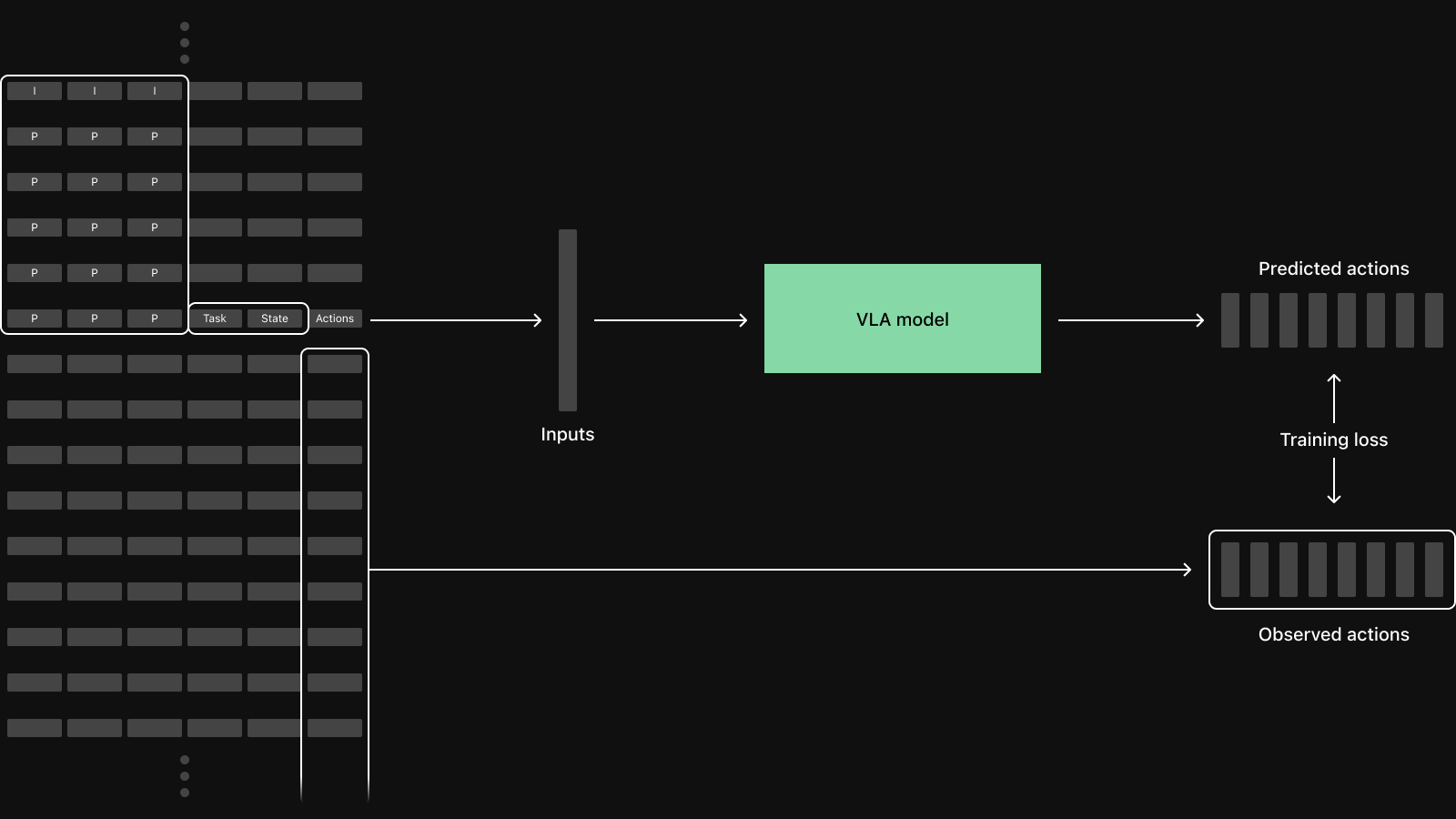
Video decoding is GOP-aware
A VideoFrameDecoder looks like a regular field from the outside, but decoding any one frame of compressed video requires running the codec from the previous keyframe forward through the target frame. The chain of frames the codec has to walk through is bounded by the GOP length:
# Decode a compressed video stream as part of each sample.
# The stream must include its sibling `VideoStream:is_keyframe` component.
from rerun.experimental.dataloader import VideoFrameDecoder

image_field = Field(
    "/camera/wrist:VideoStream:sample",
    decode=VideoFrameDecoder(codec="h264"),
)
The dataloader handles this transparently by looking up the prior keyframe, fetching the encoded samples from that keyframe through the requested outputs, and decoding them in order.
The video stream must include the sibling VideoStream:is_keyframe component.
If your recordings do not have it, run rerun rrd optimize on them before registering, which derives it from the stream.
To avoid CPU RGB conversion and reduce the size of decoded samples, keep video in YUV420 through collation.
Yuv420Collator is an optional convenience for applications whose other fields can use PyTorch's default collation:
from torch.utils.data import DataLoader

from rerun.experimental.dataloader import Yuv420Collator

loader = DataLoader(dataset, collate_fn=Yuv420Collator(), pin_memory=True)

for batch in loader:
    batch["video"] = batch["video"].to_rgb("cuda", non_blocking=True)
Applications can instead compose YUV handling into their own collator with Yuv420Frame.stack:
from rerun.experimental.dataloader import Yuv420Frame


def collate(samples):
    return {
        "video": Yuv420Frame.stack([sample["video"] for sample in samples]),
        "state": custom_state_collation(samples),
    }


loader = DataLoader(dataset, collate_fn=collate, pin_memory=True)

for batch in loader:
    batch["video"] = batch["video"].to_rgb("cuda", non_blocking=True)
Call to_rgb in the training process rather than inside a DataLoader worker when converting on CUDA.
Iterable vs. Map-style
The dataloader provides both PyTorch dataset styles:
RerunIterableDataset: streaming iteration with internal shuffling (on by default) and cross-worker partitioning. Good default. Callds.set_epoch(epoch)to reseed the shuffle between epochs.RerunMapDataset: random access by global index, plugs into PyTorch's sampler ecosystem (DistributedSampler,WeightedRandomSampler,SubsetRandomSampler, …).
Wrap either in torch.utils.data.DataLoader:
from torch.utils.data import DataLoader

from rerun.experimental.dataloader import RerunMapDataset


def my_collate(
    samples: list[dict[str, torch.Tensor]],
) -> dict[str, torch.Tensor]:
    # Drop samples that landed outside the underlying data (FixedRateSampling
    # may overshoot the end of a segment by one grid point).
    samples = [
        s for s in samples if s["state"].numel() > 0 and s["action"].numel() > 0
    ]
    return {
        "state": torch.stack([s["state"] for s in samples]).float(),
        "action": torch.stack([s["action"] for s in samples]).float(),
    }


loader = DataLoader(
    ds,
    batch_size=8,
    num_workers=0,
    shuffle=isinstance(ds, RerunMapDataset),  # iterable shuffles internally
    collate_fn=my_collate,
)
For DDP, the iterable dataset partitions the index list across ranks automatically. With the map dataset, swap in sampler=DistributedSampler(ds) and call sampler.set_epoch(epoch) each epoch.
Missing values
The live RerunIterableDataset drops a sample when any decoder returns None and warns once for each missing field.
None is the decoder contract for unresolved data; a valid zero-sized tensor is still yielded.
Null source rows and expected encoded-image or video decode failures are converted to None; a corrupt video GOP does not prevent later GOPs in the fetch block from decoding.
Custom decoders should return None for recoverable data errors; exceptions still propagate as decoder failures.
Set max_consecutive_skipped_samples to bound how many such samples each rank and DataLoader worker may skip in a row; a valid sample resets the count, and exceeding the limit raises with total and per-field counts.
The default is 1000; pass None to apply no limit.
Live samples are partitioned across workers and DDP ranks before decoding, so uneven missing data can make their yielded sample counts differ.
Use the DDP join() pattern above when consuming the live dataset to exhaustion.
For deterministic multi-rank training, generate a Manifest with the appropriate required_fields: invalid samples are removed before sharding, and replay raises if a required field has disappeared or no longer decodes instead of silently changing the frozen epoch.
RerunMapDataset cannot skip a missing item without changing its stable index mapping, so its sample dictionary may contain None for an unresolved field.
Shuffling and fetch locality
RerunIterableDataset takes a shuffle_strategy argument that controls the order samples are fetched in:
SampleShuffle()(the default): every sample lands at an independent random position. Batches are maximally decorrelated, but every fetch scatters across all segments, so the server re-reads shared storage (e.g. video GOPs) on every fetch.BlockShuffle(): cuts the sample space into fetch-sized blocks of consecutive samples (never crossing a segment boundary) and shuffles the block order, keeping the sample order within each block. Each fetch then reads one contiguous span, so the server reads each storage chunk about once per epoch instead of once per fetch. It is the only strategy that takes abuffer_size— see below.NoShuffle(): natural order, maximal fetch locality, no randomness.
For video-heavy datasets, BlockShuffle can speed up epochs by an order of magnitude, because decoding one frame requires fetching its whole GOP: with scattered fetches the same GOP chunks are re-fetched over and over.
The trade-off of BlockShuffle is that consecutive samples now come from the same contiguous block, so batches are correlated.
BlockShuffle(buffer_size=…) is the second half of that strategy: decoded samples pass through a shuffle buffer of that size and leave it in random order, mixing samples from many blocks (and thus many segments) into each batch without changing which data is fetched when.
Randomization improves smoothly with buffer size: the residual chance that two samples in a batch come from the same block falls off roughly as fetch_block_size / buffer_size, so every doubling of the buffer halves the correlation.
A buffer of a few times fetch_block_size × batch_size already gets batches close to what a full per-sample shuffle would produce, and returns diminish from there.
The buffer holds decoded samples, exactly as your decoders produce them — full-resolution RGB frames or compact YUV planes for video fields, before any resizing you do in a collate_fn.
Budget buffer_size × bytes_per_sample × num_workers, because every DataLoader worker fills its own buffer: a few thousand video samples per worker runs to tens of gigabytes.
The other cost is startup latency.
Emission starts once min_fill samples are buffered, which defaults to half the buffer, so a large buffer delays the first batch by half its size.
Lower min_fill to shorten that warm-up; the buffer keeps filling while training runs either way, so steady-state mixing is unaffected.
Only BlockShuffle accepts a buffer, because it is the only strategy whose fetch order stays deliberately correlated.
With SampleShuffle the fetch order is already fully random, so re-shuffling it on emission would cost memory without any benefit.
With NoShuffle the buffer would only jumble nearby samples, which typically means reordering within a single segment, nowhere near the cross-segment mixing training needs.
ds = RerunIterableDataset(
    source=source,
    index="frame_index",
    fields=fields,
    shuffle_strategy=BlockShuffle(buffer_size=4096),
)
Train
From there, the training loop is standard PyTorch:
for epoch in range(epochs):
    if isinstance(ds, RerunIterableDataset):
        ds.set_epoch(epoch)
    for batch in loader:
        batch = {k: v.to(device) for k, v in batch.items()}
        loss, _ = policy.forward(batch)
        loss.backward()
        optimizer.step()
        optimizer.zero_grad()
The full LeRobot ACT example wires this up against three camera streams plus state and action chunks, and trains the policy end-to-end.
Limitations
The module is experimental: expect breaking changes between releases as we iterate on the design.
For large-scale training (hundreds of recordings, multi-node), consider Rerun Hub, which offers a higher-performance backend than the OSS catalog.
References
- LeRobot ACT training example
rerun.experimental.dataloadermodule source- The data layer tax in robot learning (figures used in this guide)
- Export recordings to LeRobot datasets (inverse: Rerun → LeRobot dataset)